#002 / Substance before scale
Tuesday the 15th of September, 2026
Welcome to The Participate Playbook, #002.
Substance before scale.
At Participate World we spend our time advising on delivering community sport at scale, and the respect people in that world have for parkrun has, I’ll be honest, taken me somewhat by surprise. In fact, it wasn’t until I stepped away from my parkrun role in 2024 that I really appreciated the level of impact it has achieved. A bit like not really noticing your kids growing up because you see them every day, I guess I hadn’t ever stood back and observed things from a distance.
It’s completely understandable, of course, that people would like to emulate that success. And it is reasonable to assume that, by building on the knowledge we gained during that time, it would be possible to fast track their progress.
That is after all the entire purpose of mine and Chris’ organisation, Participate World, and this newsletter, The Participate Playbook.
However.
You can’t short-cut real-world learning.
There is no ‘hack’ that gets around the need to collide your ideas with reality, see what happens, adjust accordingly, and repeat.
And repeat. And repeat. And repeat.
And that’s the bit that people take for granted when they look at parkrun’s impact today. They see thousands of live locations across 22 countries, with half-a-million participants per week, and 150 million all-time recorded instances of participation.
They don’t notice the first six years (and more) where it was just a few groups of people in a few parks and open spaces. Turning up, walking, running, volunteering, and going for coffee.
Week after week after week after week.
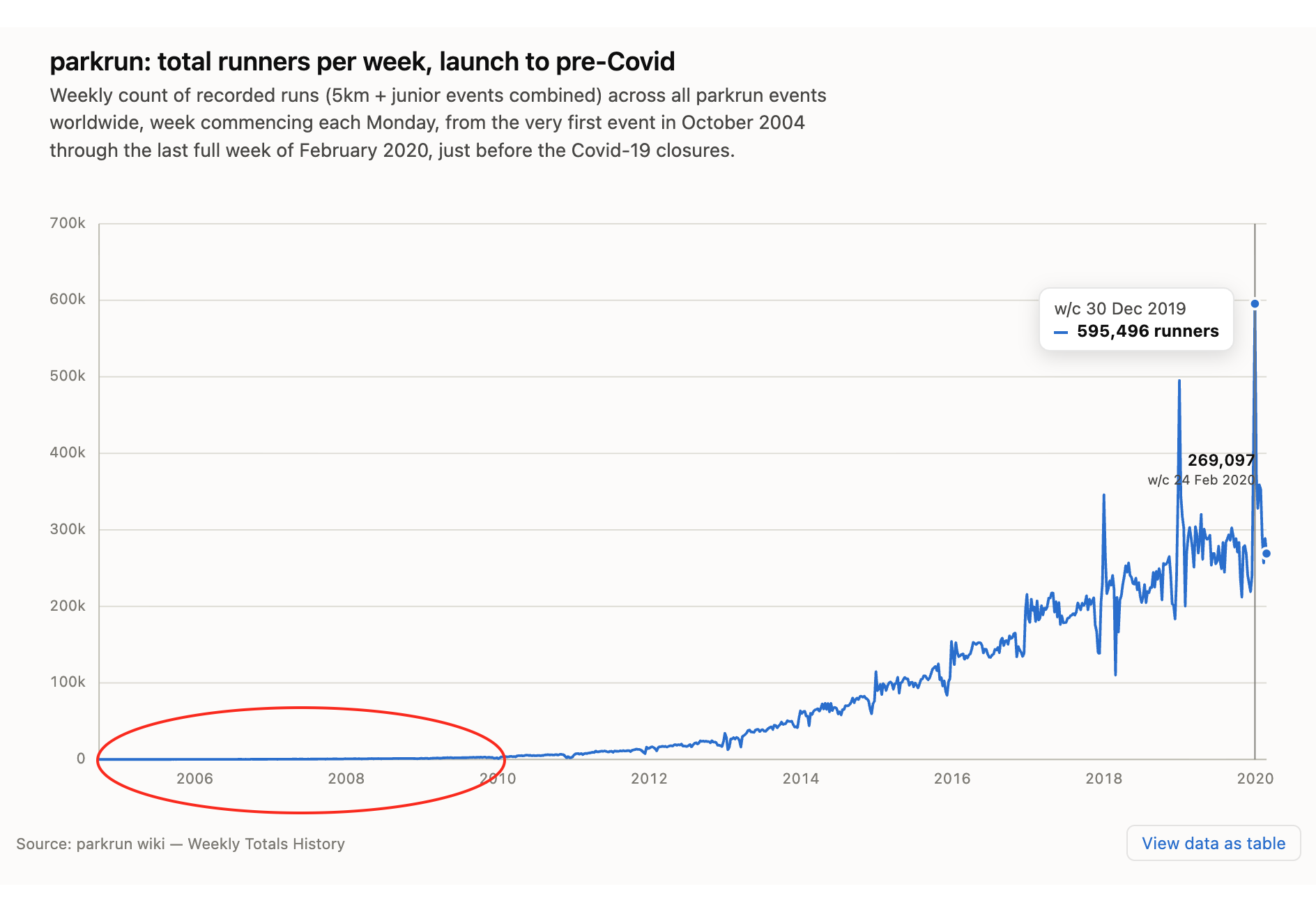
That graph above shows weekly parkrun and junior parkrun finishers from October 2004 until just before Covid. The bit with the red oval around it is the first six years, and I’d suggest that what we learned during those initial 300-or-so weeks was more important than during any other time period.
We learned that things like kilometre markers or perfectly laid-out courses weren’t needed, and that spending all day getting the results to be absolutely perfect was a serious false economy. We decided that dogs should be on leads and that children under the age of 11 should be accompanied by adults. We started events in all four home nations, and even dabbled in Denmark (and Zimbabwe for a bit). We worked with a whole host of commercial and strategic partners, learnt a whole load about volunteering, and realised that parkrun wasn’t really about the run. We even rebranded from UK Time Trials to parkrun, and launched the now famous milestone clubs to recognise participation and inspire others.
Perhaps most importantly of all however, it was during that time that we brought in barcodes to identify people, massively reducing the time taken and mistakes made when recording participation at our events.
In the very earliest events (before my time) results were recorded with stopwatches, clipboards, and pencils. Then metal finish position tokens were introduced, and by the time I registered in August 2007 there was a database with 6,000 names and email addresses, and everyone had a unique identifier (mine being A6013).
As we continued to grow however, our systems were straining under the sheer number of similarly-named people. Volunteers at events were making mistakes, marking the wrong people as taking part, and having to spend hours every week correcting these errors. On plenty of occasions I remember half my Saturday and several hours during the week being taken up by one John Smith saying he was there but didn’t have a result, and another John Smith saying he wasn’t there but did. Asking everyone to print out a barcode that represented their personal parkrun number, and bring it to each event to be scanned, was a super simple solution that almost entirely stopped cases of mistaken identity. It was the final piece in the results-processing jigsaw that allowed parkrun event teams to process results quickly and accurately.
Without it, parkrun could never have got anywhere near the size it is today, and as testament to the scalability and effectiveness of that system it’s still used today. And a paper barcode printed out 17 years ago in Leeds could, if it had been incredibly well cared for, be taken to any one of 3,000 global locations this coming weekend and used to record that person’s presence.
So much of what you see today was developed during that time on the graph where it looks like nothing was happening. In reality however, we were living and breathing free, weekly, timed, 5k-running-events-where-walking-was-welcome, and gradually perfecting our delivery model until such a point where demand would increase and scale would be possible.
Comment
If we’d had all the advice in the world at the time, I don’t think we’d have been able to invent the 2009 parkrun results system in 2004. We simply didn’t have the real-world experience of doing the thing, seeing what happened, and iterating repeatedly over time. We’d have made an educated guess, and probably come up with a far too complex solution that worked for a few hundred people but collapsed under the weight of a few hundred thousand.
Interestingly, over the years a number of very well established event organisers (across a number of different countries) have attempted to replicate parkrun from scratch. Each time they’ve launched with what I assume they’ve assumed was a more advanced system, and pretty much each time it’s not really worked. And my suggestion is that this has been due to a desire to leap straight over that first six-year learning period and go straight to scale.
In parkrun terms, people want to start in 2010 not 2004.
And whilst minimising the time taken from first idea to first actual thing is absolutely critical, taking the time to patiently learn over the period that follows is often the difference between success and failure.
Tom Williams
Co-Founder, Participate World
participateworld.org
The Participate Playbook newsletter reflects Tom Williams' personal experience and recollections from his time at parkrun. It is not an official parkrun position or record, and any errors are unintentional. Tom writes as an independent consultant through Participate World Limited, and neither he nor the company are affiliated with, employed by, or representatives of parkrun Global or any of its group companies.
