#001 / Three reasons why parkrun isn’t a race. IMHO.
Tuesday the 8th of September, 2026
Welcome to The Participate Playbook, Number 001.
Three reasons why parkrun isn’t a race. IMHO.
This is something that I’ve thought about thousands of times over the last 19 years, something that I’ve changed my opinion on over that time, and something that is probably talked about more than any other parkrun topic. Plus, there’s no objective answer. It’s a matter of opinion, and this is mine.
Going back to parkrun’s origins, Bushy parkrun was originally called the Bushy Park Time Trial, and the first ten or so events followed suit. And when we started what’s now called Woodhouse Moor parkrun, back in 2007, it was actually called the Hyde Park Time Trial. It was promoted as ‘you against the clock’ and had race reports, race directors, winners, and an annual points league where you were rewarded based on weekly finish positions.
To all intents and purposes, parkrun started out as a race.
Sort of.
Because even in the very early days there were signs that perhaps that wasn’t quite a fair interpretation. There was from day one, for example, a very clear position that no one should be disqualified and it was up to participants to follow the correct course. And a relaxed attitude to guaranteeing a perfect set of results. You could always come back next week or 'request a refund'.
Nevertheless, in the early years, where we were publicly claiming it wasn’t a race, I would often argue in private that it absolutely was.
However, over time, as I got more involved and my understanding grew, various experiences moved my opinion in a different direction.
Reason 001 - Inclusion
At one early event there was a person who had experienced a stroke and would take a relatively long time to complete the three-lap course. This was of course absolutely fine with the volunteers, but this person felt so uncomfortable being so far behind everyone else that they didn’t feel comfortable taking part. The event team suggested they just completed two laps and crossed the line in the middle of the field, which they did. This meant that they were covering one mile less than people they were finishing ahead of, but of course no-one minded. The community was being a community (credit Clare Fowler, parkrun Safeguarding Lead for that term), and someone who otherwise wouldn’t take part was taking part.
In another example, a young person with severe disabilities was only able to participate using a wheelchair, but was also unable to propel themselves at all. They were pushed round the course by their Mum, and when I found out about it I quickly suggested that they should still qualify for a token and a time. Because why not?
But to my very pleasant surprise it turned out that the local event team were already doing just that, of course. And so here was another person finishing ahead of others, in this case without expending any energy at all, yet receiving a time, age grade, and finish position.
That wonderful story was the genesis of the current wheels at parkrun policy, and something that we were very proud of in the operations team.
There are now, of course, endless of examples of local parkrun communities prioritising inclusion over competition and, in my opinion at least, that's the right thing to do. The alternative being to not let these people take part, or come up with some kind of complex process that includes them without including them (see Reason 003).
Reason 002 - Protecting Races
Many people involved in parkrun over the years are or have been incredibly passionate about competitive athletics. Although never elite, I myself have taken running and triathlon races pretty seriously over the years, trying and just failing to qualify for the Hawaii Ironman. Plus during my time at parkrun I was lucky enough to work or collaborate with amazing people like Chrissie Wellington (four time Ironman world champion and parkrun’s Global Head of Health for over a decade), Dave Moorcroft (5,000m world record holder and one-time non-exec Chair of parkrun UK), and Bruce Fordyce (the Comrades King, head of parkrun Southern Africa, more on him later).
Races are wonderful things and for many reasons proper competitive sport is incredibly important to society. As such, it is important to understand what a race really is, what it means to put one on, and why that to do so properly incurs additional costs. Further, if we want races to thrive then we need to create an environment where race organisers can develop a successful business model that more than pays the bills.
Yet there came a point around 2013 where we felt that the success of parkrun had the potential to undermine paid races, particularly, for example, as in the Power of 10 (the UK’s formal record of race performances) many of our events were given the same status as official races. This was a problem, both for races themselves, as people were starting to see parkrun as a free alternative (and why not if it could formally count as a race performance), and for parkrun volunteers, as they came under increasing pressure to ensure course and time accuracy, and to adjudicate disputes around ‘cheating’.
Around this time, we also had really productive meetings with the Association of UK Course Measurers (who are brilliant by the way, and very much under-recognised), who had very kindly offered to measure parkrun courses for free. But they were also keen to point out (and rightly so) that claiming a course was professionally measured (which we did at the time) wasn’t correct. That would mean it would need to be exactly the same every week and that proper steps were always taken to ensure corners couldn’t be cut and the exact course would be followed. All of that, of course, takes time and money, and in the context of putting on a proper race should be done professionally.
We therefore took the (at the time somewhat, ahem, controversial) step of asking Power of 10 to create a new category, especially for us, and separating us from races. We wrote about it here.
It was always our ambition that parkrun would support races across the countries in which we operated, and that that should be both in terms of increasing the population of people who run, but also not competing with race organisers (which requires clear differentiation).
Reason 003 - Challenges of Scale
This year, parkrun will deliver in the region of 140,000 events, and all-time they’ve delivered north of one million.
That’s events, not participants. And for context, although I don’t know the exact numbers, I imagine at some time in the coming years there will have been as many parkrun events as all-time London Marathon finishers.
Delivering at that totally unprecedented level of scale requires extreme operational simplicity. And with half-a-million participants per week, you only need a very small percentage of them to raise challenges related to fair competition and the whole thing stops working. In no time at all the volunteers and staff would be swamped with requests to re-certify courses, investigate allegations of cheating, and ensure higher accuracy of finish times.
Now, I’m not the most prolific of volunteers, but when I have been a parkrun run director I've just wanted to process the results quickly and painlessly, to a reasonable but not obsessive level of accuracy, and get on with my day.
More often than not these days I’m a parkrun runner, and where my finish token doesn’t line up with my published position, or my official finish time with my Garmin (on Saturday there was a six-second discrepancy between my time and the time), then that’s fine. I don’t write to the volunteer team demanding action. At a paid official race however, I might well drop them a note.
Had we attempted to deliver the operational requirements of a race at scale, there is absolutely no way parkrun would have had anything like the impact it has done already and will do in the future.
Racing is welcome though
So, those are my three justifications as to why parkrun shouldn’t be considered a race, and why to the best of the knowledge parkrun doesn’t apply rules of competition. The most obvious example of which would be where athletes have been convicted of doping and (rightly) banned from competition, they are still welcome to participate at parkrun events.
In the spirit of full transparency however, I would like to sign off with my greatest ever ‘racing at parkrun moment’.
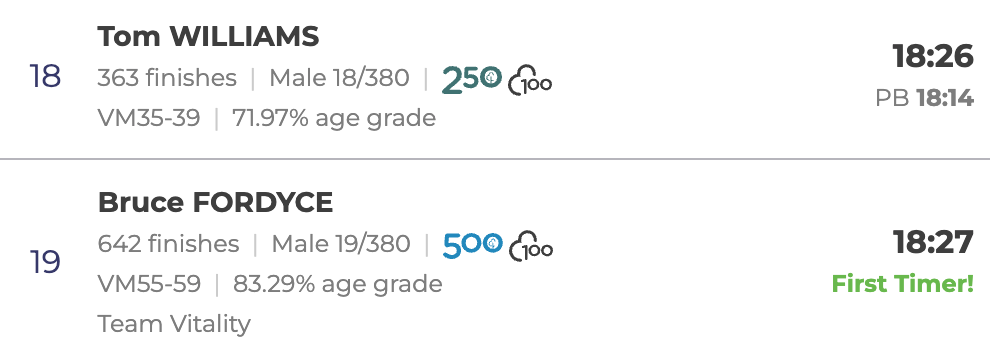
In April 2011 I was in London for the Marathon, and headed to Bushy Park on the Saturday, where my now good friend Bruce Fordyce was in town. He was partly there for the Marathon, and partly as we were trying to persuade him to start parkrun in South Africa.
My Dad’s South African and so I’d grown up listening to stories of Bruce’s running heroics, plus I’d interviewed him in 2010 for Marathon Talk (Episode 38 and Episode 39), so I was very aware of who he was.
The first time I met him in person however, was as I strode 'majestically onto his shoulder around the 4k point at that Saturday’s Bushy parkrun. We then spent the next kilometre locked in battle, fighting with all we had to reach the finish line first. Fortunately for me, I pipped the great man by one single solitary second, and have lived off that glorious victory every day for the last 15 years.
Let’s not talk about age grade.
We were of course racing, but had Bruce cut the final corner and dipped ahead of me, my argument would have been entirely with him. Not the volunteers putting on Bushy parkrun that day, or parkrun HQ itself.
We were racing. It wasn't a race.
Comment
When developing or guiding a community sport initiative or organisation (or any organisation for that matter) it’s critical that we consider every decision we make from every angle we can make it from.
Not to over-think things, but to recognise that we need to understand our moral and ethical obligations to ourselves and those we serve, plus the impacts on others that may be outside of our direct stakeholder group and, equally importantly, what’s actually possible and pragmatic to deliver in the real world.
If we’d got these decisions wrong (which in the early days would have been the easier path), we would have excluded the people most in need of parkrun, massively undermined paid races, and eventually collapsed into an unsurvivable bureaucratic swamp of disputes, challenges and counter challenges relating to fair competition.
We’d love to hear from you if you have similar experiences or are facing similar challenges.
And if you’ve got any questions on this week’s Playbook or would like to work with us in relation to your organisation then simply reply to this email and we’ll be in touch.
Thanks for being here,
Tom
P.S. If you're enjoying this newsletter, we'd love you to share it with your contacts.
Subscribe to future editions of The Participate Playbook
Tom Williams
Co-Founder, Participate World
participateworld.org
The Participate Playbook newsletter reflects Tom Williams' personal experience and recollections from his time at parkrun. It is not an official parkrun position or record, and any errors are unintentional. Tom writes as an independent consultant through Participate World Limited, and neither he nor the company are affiliated with, employed by, or representatives of parkrun Global or any of its group companies.
Bushy parkrun #352
We were racing.
